Research on how social presence shapes eating behaviour and intake
Research on eating behaviour reveals that the presence of others significantly influences food intake, meal duration, and eating patterns. Social eating typically results in extended meal duration compared to solo eating. Longer meals provide greater opportunity for physiological satiety signals to develop, yet may also extend total eating time and increase absolute intake quantity.
The social context modulates eating through multiple mechanisms. Conversation, relational dynamics, and attention allocation to social interaction rather than solely on eating affect how much individuals consume. Social eating often occurs in more formal or leisurely settings, with greater food variety and abundance than solo meals.
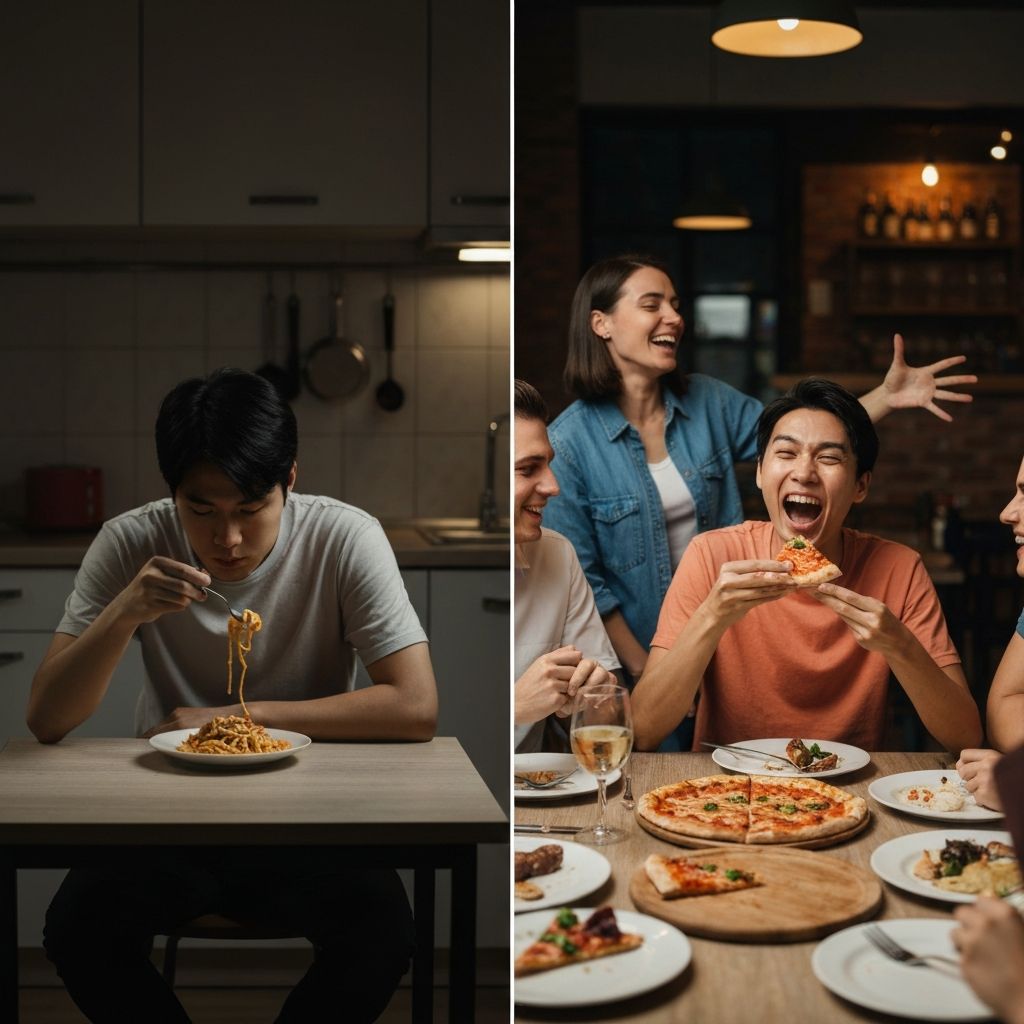
Social meals consistently last longer than solo meals. Research shows social meals average 20-30 minutes, while solo meals often last 10-15 minutes. This extended duration affects satiety development. Slower eating pace permits stomach stretch receptors and nutrient-absorption signals to register more completely before additional food is consumed.
However, extended meal duration can paradoxically increase total intake. The longer people sit with food available, the more likely they are to continue eating past physiological satiety. Social facilitation—increased consumption in social settings—is well-documented, particularly when food is abundant and conversation ongoing.
Intake quantity in social settings depends on multiple factors including group size, familiarity with companions, and social norms. Larger groups typically produce greater total intake than dyads or smaller groups. Familiar companions may moderate intake through established social norms; unfamiliar dining partners may produce different effects.
Social modelling—unconsciously matching companions' eating pace and portion size—is a powerful influence on intake. Individuals eating with high-intake companions tend to eat more; eating with low-intake companions typically reduces personal intake. These modelling effects operate largely outside conscious awareness.
Social eating typically produces greater subjective pleasure and satisfaction than solo eating. Shared meals enhance palatability perception through social engagement and enjoyment of companions. Food tastes better in pleasant social contexts; the same meal consumed alone produces different sensory experience.
Psychological satisfaction from social eating extends beyond sensory pleasure. Belonging, connection, and relational nourishment during shared meals produce wellbeing effects that augment physical nourishment. These psychological dimensions of eating are absent in solo consumption.
Social eating divides attention between food and social interaction. This divided attention may reduce awareness of fullness signals, potentially resulting in overconsumption. Conversely, positive social engagement may enhance overall satisfaction, reducing post-meal hunger recurrence.
Solo eating permits focused attention to food sensations and hunger/satiety signals. However, eating alone may also involve distraction—screens, work, or reading—that similarly reduces hunger awareness despite lack of social engagement.
Social eating norms vary across cultures and subgroups. Cultures with strong shared-meal traditions (Mediterranean, Latin American, many Asian traditions) emphasise social eating for relational and identity purposes. Rapid, individualised eating cultures (some Western patterns) permit greater solo eating frequency.
Family eating patterns established in childhood produce lifelong effects on eating behaviour. Families with regular shared meals typically show different eating patterns than families with primarily solo eating. These learned patterns represent internalised social eating contexts that persist even when actual social eating is absent.
Relational eating—eating in the presence of valued others—serves important social and identity functions beyond nutrition. Shared meals facilitate bonding, cultural transmission, and belonging. These dimensions explain why universal promotion of either solo or social eating misses the human context of eating.
Understanding eating behaviour differences between solo and social contexts provides perspective on normal eating variation. Neither solo nor social eating is inherently superior; both are valuable contexts. Frequent solo eating allows focused attention to hunger/satiety signals; regular social eating provides relational nourishment and pleasure.
Recognition that social context powerfully influences eating explains why identical eating guidance produces different outcomes for different individuals. Psychological, cultural, and relational contexts are inseparable from eating behaviour—not extraneous to nutrition.